Playing The Corrupt Game in the Ereklasse
The recent comments attributed to Mitch McGahan regarding Rotterdam Rugby Club (RRC) in AD.nl are disappointing and, more importantly, factually incorrect. Didn’t Eemland have a player banned for substance abuse? Spirit of the game, right? (alleged)
To suggest that Rotterdam acted against the “spirit of rugby” is simply false. Let me explain why, with reference to the actual rules, not rumours. Mitch seems to be happy to file claims when he loses to Rotterdam, they lost 48 -7 two weeks ago and yet they think they deserve a semi-final spot? Eemland rugby have massively underperformed in relation to the their budget (particularly coaching), and they are now using their financial and political power within Rugby Netherlands to manipulate the results of this season. That desperate behaviour to cover up poor performance goes directly against the core values of rugby: Integrity, Respect, and Discipline.
No rule was violated
First, within the VWW regulations, Rugby Nederland’s own rulebook, there is no clear rule prohibiting a player from representing both a Future Class team and an Ereklasse (Premiership) team in the same round under the circumstances that occurred.
The provision relied upon by the Competition Leader (Appendix 10.1 4) states that a player “mag” — may — appear as a substitute. It does not say “may only”. It does not say “must be listed as a substitute on the match form”. It does not say “may not appear as a starter”.
A permissive rule cannot be turned into a prohibition. That is not interpretation. That is rewriting the rulebook.
Eligible players are eligible
Second, claims regarding an “ineligible player” are also incorrect. The player was fully registered within the Rugby Nederland system, had a valid bondnummer, and was cleared to play. If a player is properly registered and approved within the official competition system, then by definition they are eligible to participate.
The VWW itself defines “speelgerechtigd” (eligible) in Article 3.0.6.2: registered with photo, bondnummer, clearance or dispensation where needed, and no suspension. RRC met every single requirement. There is no finding, and there can be no finding, that an ineligible player took the field.
The U21 rule and playing time limits
Furthermore, the regulations explicitly provide that players under the age of 22 may move between teams without restriction. The only applicable limitation concerns the maximum of 120 minutes played within one match weekend, a rule designed for player welfare, not for paperwork technicalities.
Rotterdam Rugby Club complied with this rule fully and remained within all prescribed limits under the VWW. No competitive advantage was gained. The match was fairly contested. The outcome was determined on the field, not in an administrator’s office.
Inconsistency that cannot be ignored
What is even more concerning is the apparent inconsistency in how these matters are handled.
During the hearing, the Competition Leader stated that referees are contacted weekly to verify whether clubs comply with regulations. Yet when another club fielded a Future Class player in their First XV on the same day against RRC, no action appears to have been taken and no points were deducted.
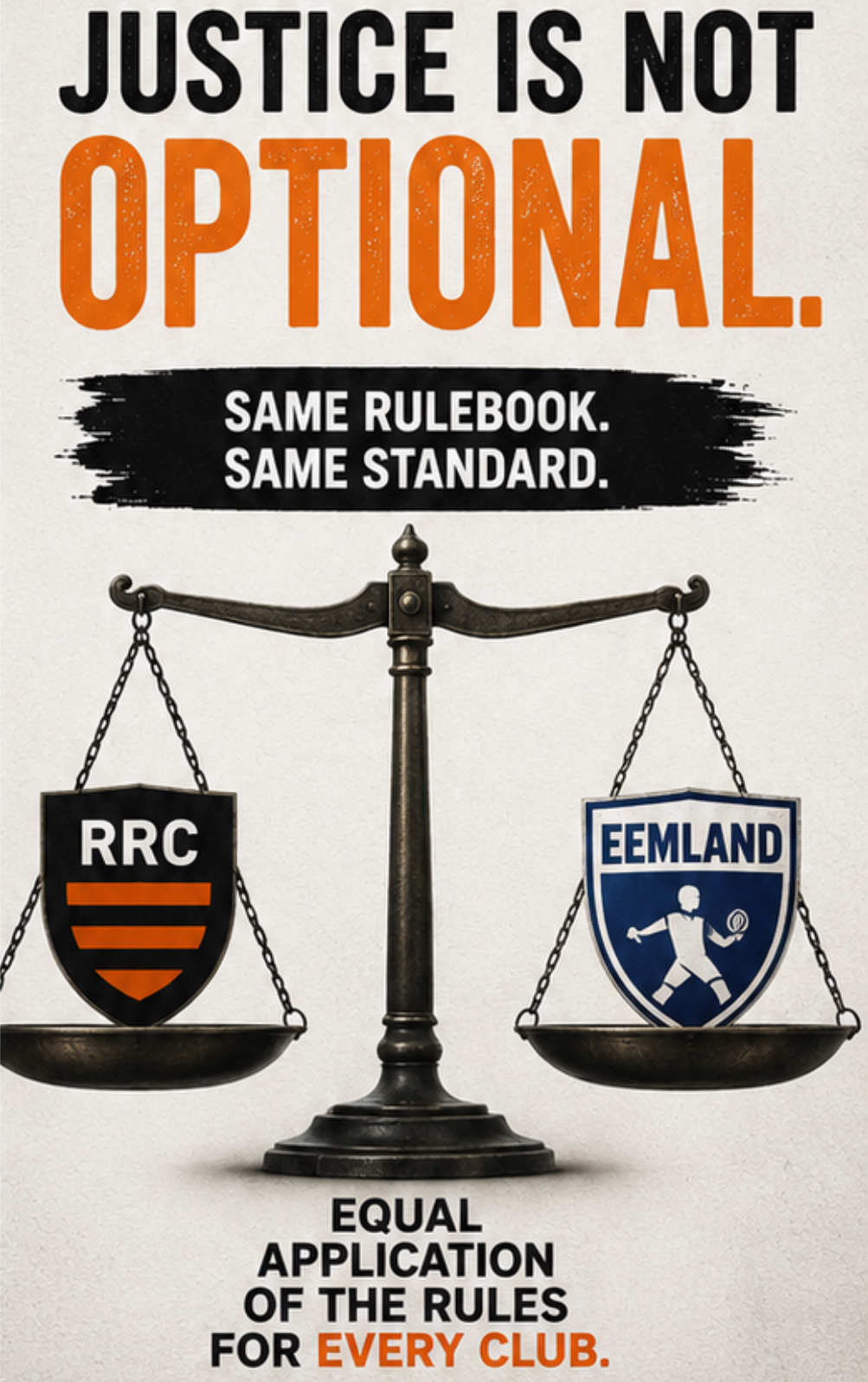
Why is one club sanctioned and another not? Where is the equal application of the rules?
In addition, Rotterdam was sanctioned over a match played on 25 October 2025, yet the appeal hearing only took place on 8 May 2026. According to the VWW (Article 3.0.14.5), a decision on a claim must be made within three working days. That deadline was ignored. Serious questions must therefore be asked about consistency, process, and equal application of the rules.
Clubs encouraged to file claims
Finally, it is deeply concerning that there have been credible reports of clubs and individuals being approached and encouraged to file claims against Rotterdam Rugby Club. Witnesses have reported such approaches, including players and coaches.
That behaviour would go directly against the core values of rugby: Integrity, Respect, and Discipline. It would also potentially fall within the definition of match fixing or competition manipulation under World Rugby Regulation 6, which prohibits any improper influence on competition outcomes.
Rugby Nederland has a duty to investigate such reports. To our knowledge, no investigation has been opened. That failure itself is a governance scandal.
Who governs the governors?
Let me ask the questions that no one at Rugby Nederland seems willing to answer:
- On what date did the Board approve the 2025-2026 VWW? Where is the approval signature?
- On what date did these regulations become effective? The Youth Rules have an effective date (1 August 2025). The Senior Rules do not. Why not?
- If the rules lack an effective date and board approval, on what legal basis is Rugby Nederland enforcing them, let alone imposing 30-0 forfeits and 5-point deductions?
- Why are some clubs punished and others not, for what appears to be the same administrative practice?
- Who is investigating the reports of clubs being approached to file claims against RRC?
Rugby values must apply equally to everyone, not selectively
Rotterdam Rugby Club has always acted within the framework of the regulations. We will continue to stand for fairness, transparency, and the integrity of the game.
But integrity is not a one-way street. It applies to the federation as much as to the clubs. If Rugby Nederland cannot produce a dated, approved, signed, and consistently applied rulebook, and if it cannot investigate credible reports of improper conduct, then the federation is failing in its most basic duty.
Its ok, you can play your semi-finals next week, you know fully well that you didnt get there on pure merit. The Ereklasse deserves better. Rugby deserves better.








 English (UK)
  English (United States)
Post Comment